You Don’t Need an AI Strategy. You Need a Work Redesign Strategy.
AI transformation doesn’t happen when you adopt the tool. It happens when you redesign the work.
AI transformation doesn’t happen when you adopt the tool. It happens when you redesign the work.
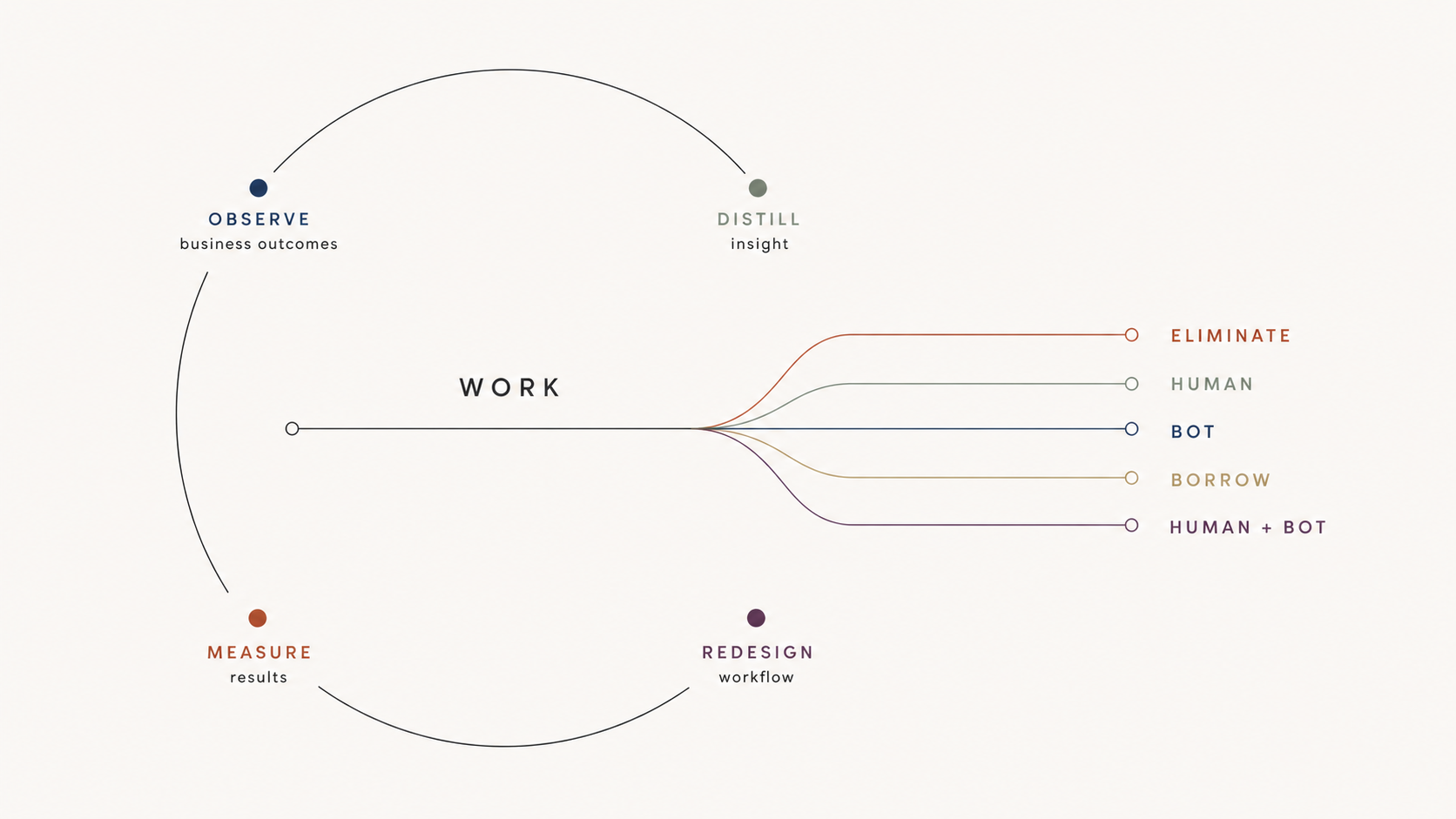
Across industries, leadership teams are investing heavily in AI. They are purchasing enterprise licenses, launching pilots, forming steering committees, collecting use cases and encouraging employees to experiment. They are tracking adoption and celebrating the hours employees report saving.
All of that may be useful.
But it is not transformation.
AI does not create business value simply because employees use it. The value comes when a company changes how work gets done—and turns that change into greater capacity, better quality, faster execution, lower risk, a better customer experience or stronger margins.
That distinction matters because many organizations have a great deal of AI activity without much to show for it in their business results.
Employees may be writing emails faster, summarizing documents, preparing first drafts or accelerating research. Yet the company still has the same workflows, the same handoffs, the same approval layers, the same organizational structure and the same operating model.
People are saving minutes. The company is not necessarily producing more.
The problem is not a lack of AI adoption. It is a lack of work redesign.
Most organizations begin their AI journey by asking:
Those questions are understandable, but they start in the wrong place.
The more important questions are:
Without answers to those questions, “hours saved” can become a largely theoretical measure.
If AI saves 10,000 hours but the organization never changes how much it produces, how quickly it operates, how it serves customers or what it costs to run the business, it has created potential capacity—not actual business value.
That does not mean the investment failed. It means the company has completed only the first part of the work.
The best opportunities for AI are rarely found by starting with a catalog of what a tool can do. They are found by looking closely at how work actually moves through an organization.
Consider a process that appears on the surface to be a single job: reviewing a contract, resolving a customer complaint, preparing a forecast, recruiting an employee or producing a management report.
Each is really a collection of different kinds of work:
AI may perform some of those activities extremely well. Others may continue to require a person. Some may disappear altogether once the workflow is redesigned.
That is why leaders should not begin with the job title—or with the software. They should begin by breaking down the work itself.
AI transformation doesn’t happen when you adopt the tool. It happens when you redesign the work.
Once the work is visible, leaders can make better choices about what should be built internally, handled through a partner, bought from a provider, performed by people or assigned to bots and agents. Then they can redesign the workflow around what each does well—and where each falls short.
Imagine that AI reduces the time required to complete a recurring analysis from ten hours to three.
That is a meaningful productivity improvement for the person doing the work. But it does not automatically create seven hours of value for the company.
To capture that value, leadership must decide what changes next.
Will the employee complete more analyses? Will the company serve more customers? Will decisions be made faster? Will the role absorb work that previously required another position? Will the company reduce outside spending? Will it improve quality, lower risk or stop doing work that no longer adds enough value?
Unless the organization makes that second decision, the company may never benefit from the time the employee saved.
This is why AI transformation cannot be delegated entirely to the technology team. Technology leaders determine what is possible. Business leaders decide what should change. People leaders help redesign roles, skills, incentives and accountability. Legal and risk leaders establish the boundaries that allow the organization to move forward responsibly.
Meaningful change requires all of them.
The question is not simply whether AI can perform an activity. The question is whether the organization can responsibly and reliably allow it to do so.
Leaders need to ask several questions about the work:
A repeatable activity with easily verified outputs and limited consequences may be a strong candidate for automation.
An activity involving consequential judgment, difficult-to-detect errors or significant legal, financial or reputational exposure requires a different design. AI may still support the work, but the workflow needs appropriate review, escalation and accountability.
The answers determine where AI can act independently, where a person should remain involved and where AI may not be appropriate at all.
Organizations that ignore it tend to move in one of two directions: too slowly, because every AI application feels dangerous; or too quickly, without understanding where the real risk resides.
Good governance should not exist simply to restrict AI. It should give people enough clarity to use it responsibly.
It is tempting to describe the future of work as a competition between humans and machines. That framing is too simplistic to be useful.
The more immediate challenge is designing ways of working in which people and AI perform better together than either would independently.
That requires more than giving employees access to a tool. Leaders must decide:
These are not merely technology questions. They are questions about how the organization will operate.
They affect organizational structure, roles, staffing, performance measures, management practices and leadership expectations. They also affect how companies hire, develop and reward people.
AI strategy cannot sit off to the side, separate from decisions about the workforce and the business. Increasingly, they are the same conversation.
Adoption metrics can tell leaders whether employees are experimenting. They cannot, by themselves, demonstrate whether the company is becoming more effective.
The more useful measures are business outcomes:
The right measure will vary by workflow. But it should connect the redesigned work to a result the company actually values.
Otherwise, AI risks becoming another layer of technology added to an already complicated organization.
Before purchasing another tool or launching another pilot, leadership teams should ask:
The organizations that benefit most from AI will not necessarily be the ones that purchase the most advanced tools or launch the greatest number of pilots.
They will be the ones willing to examine how work actually happens, make deliberate choices about what people and technology should each do, and then change the organization accordingly.
Because the goal is not to become a company that uses AI.
The goal is to become the company AI makes possible.